It can be hard to find the right balance between pushing performance and allowing time to recover. Wearable trackers—my go-to is Whoop—can clarify that balance by turning physiological signals into actionable insights so you know when to train hard and when to rest.
Click play to listen right on this page, no app needed:
Or listen on your favorite podcast app: iTunes (Apple Podcasts) | Spotify | Stitcher
Want a free week of strength workouts? Click here to get started!
Key Takeaways
If you want to use a recovery tracker to improve your recovery, follow these principles:
- Choose a tracker that delivers science-based metrics and personalized analytics.
- Factor in the menstrual cycle and its effects on training and recovery.
- Accept that rest is essential to achieving long-term progress.
Making Data-Driven Decisions with Emily Capodilupo
Emily Capodilupo is Senior Vice President of Data Science & Research at Whoop. With a background in neurobiology from Harvard and experience as a gymnast and runner, Emily combines scientific training and practical athletic experience to help people make smarter, data-driven decisions about sleep, recovery, and training.
Recovery Is Non-Negotiable
Rest affects athletic, cognitive, and emotional performance. Although we spend roughly one-third of our lives sleeping, its full purpose remains a scientific mystery. What is clear: adequate recovery is required to translate effort into gains. Training hard without recovery undermines progress and increases injury risk.
Trackers like Whoop turn continuous vital-sign data into insights—sleep, heart rate, heart rate variability (HRV), and respiratory rate—to show how recovered you are and how to adjust training to meet your goals.
Closing the Research Gender Gap
Emily highlights a persistent problem: females are underrepresented in exercise physiology research. Historically, studies often excluded women, leaving a gap in evidence about how to train and recover optimally for people with ovaries. Whoop is working to change that by leveraging large-scale wearable data to study sleep, recovery, and menstrual cycle effects in ways traditional academic research often cannot.
Understanding menstrual cycle phases and their physiological effects enables smarter training strategies that can make fitness more efficient and safer.
Ready to use science-backed guidance to improve performance and recovery? Share your thoughts in the comments below.
In This Episode
- How data collection and algorithms complement human physiology (7:58)
- Factors considered when calculating Whoop’s recovery score (17:25)
- Why closing the gender gap in exercise physiology research matters (29:22)
- What Whoop’s research reveals about menstrual cycles (38:43)
- How to adapt training by cycle phase, life stage, and more (45:52)
Quotes
“It is a pretty powerful metric of how ready your body is to adapt to the varying stimuli you may be exposed to that day.” (19:21)
“The recovery score… translates into all these different things. So both your ability to perform, as well as your risk of potentially getting injured.” (24:32)
“By neglecting research into how to comfortably and safely exercise as a person with a uterus… we are kind of setting these people up to opt out and therefore reduce their health later in life.” (36:54)
“We have collected data from thousands of perimenopausal and menopausal females… We are excited to be a part of closing that gap.” (51:08)
“When we make stuff up, we are at such a high risk of getting it wrong and doing this huge disservice to a population who wants to do it right.” (53:37)
Featured on the Show
Apply for Strength Nutrition Unlocked Program
The Locker Blog
Sleep-Wake and Mental Health Resilience Study
Check out the full show notes here!
Support the Podcast
Get 20% off Legion Supplements with code STEPH
Get your first month of Whoop free ($30 off)
Save 10% off GORUCK with code FUELYOURSTRENGTH
Follow Steph on Instagram
Rate and review on Apple Podcasts
Related Episodes
LTYB 342: Fitness Trackers and Listening To Your Body
LTYB 354: 5 Sleep Tips for Better Recovery
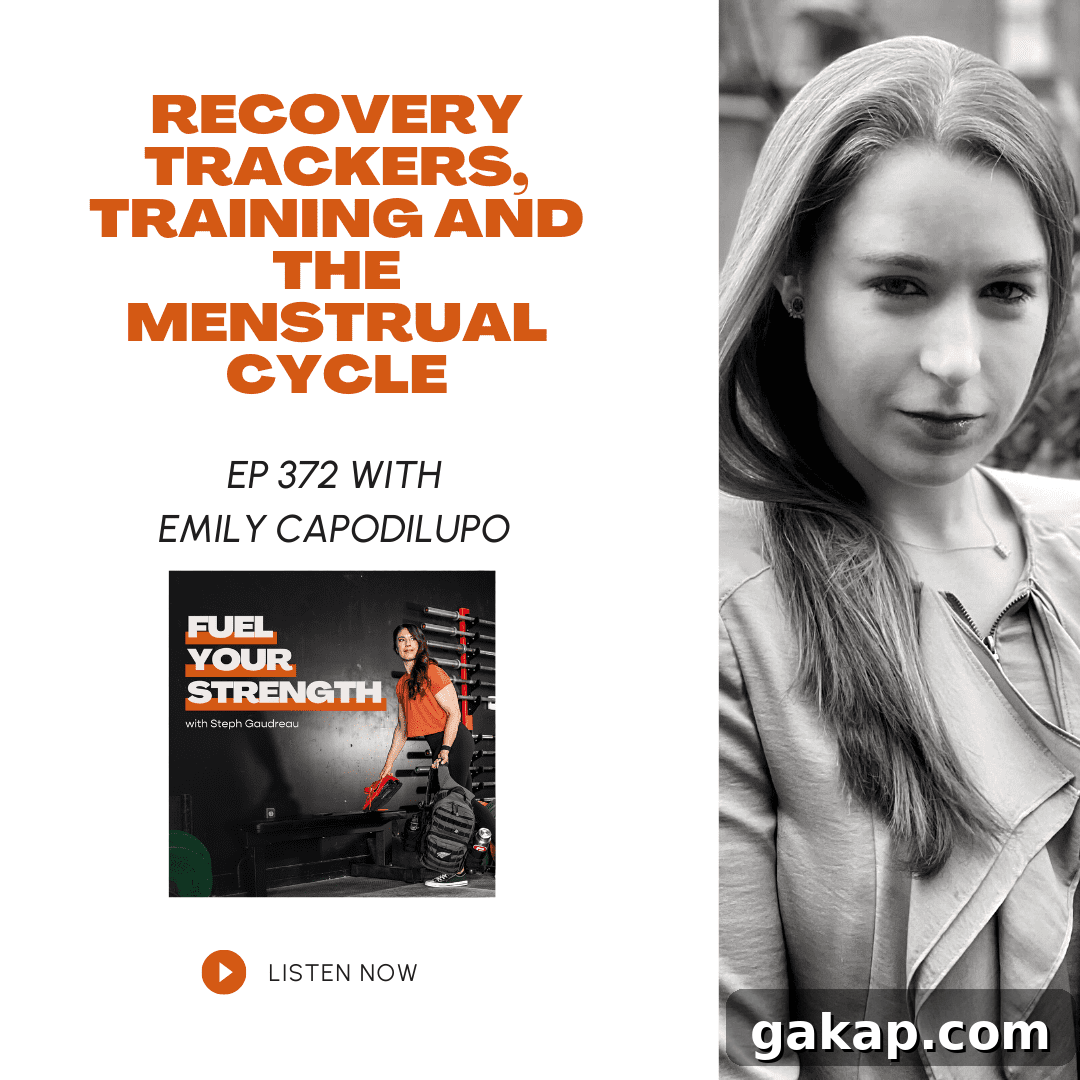
Recovery Trackers, Training and the Menstrual Cycle w/ Emily Capodilupo
Steph Gaudreau
Do you struggle to take a rest day even when you feel worn out? You’re not alone. Women in their 40s and beyond face choices about when to push and when to back off. Today’s guest gives a close look at data and analytics for performance and recovery, and discusses the gender gap in research that affects training and long-term health.
If you’re an athletic woman who loves lifting, running, and challenging yourself, the Fuel Your Strength podcast offers evidence-based strategies for eating, training, and recovering smarter so you build strength, gain energy, and perform better in and out of the gym.
Data and Science on Women in Sport
Emily Capodilupo joined Whoop after research experience in sleep medicine at Harvard. At Whoop she leads work that turns continuous physiological data into algorithms and research-driven features focused on sleep and recovery. Her team creates models that translate vital signs—resting heart rate, HRV, respiratory rate, and sleep—into individualized guidance for training and recovery.
What is Whoop?
Whoop is a wearable designed for around-the-clock use with a focus on recovery and sleep rather than step counting. The product continuously collects physiological data and uses algorithms to provide personalized feedback, a sleep coach, recovery scores, and training recommendations designed to help users meet their goals.
What is the Recovery Score?
The recovery score combines resting heart rate, heart rate variability (HRV), respiratory rate, and sleep metrics. These inputs are compared to your personal baseline over recent weeks and months to determine readiness on a 0–100 scale. Higher HRV and favorable sleep and respiratory patterns raise your score; the system then predicts how well you can adapt to training that day.
Recovery Score Color Meanings
The score is simplified into a traffic-light system: green (67–100) means you’re well recovered and ready to perform, yellow (34–66) suggests moderation, and red (0–33) signals that you should reduce training load. Adjustments like naps, good hydration, and nutrition can improve recovery, while alcohol and poor sleep can lower it.
In studies like Project PR, athletes who reduced training on red days achieved the same performance gains as those who followed rigid plans but sustained far fewer injuries—showing smarter recovery modulation protects progress while lowering injury risk.
Giving Athletes Permission to Slow Down
Whoop was founded to counter the “always push harder” mentality. Overtraining can derail performance: monitoring recovery gives athletes permission to rest when needed so they can return stronger. Properly timed rest helps translate training stress into gains rather than fatigue or injury.
Research Gender Gap
Females make up a small fraction of exercise physiology research subjects. A review covering 2014–2020 found only 6% of top exercise physiology studies focused on female physiology. The historical tendency to use male medical students as the “default subject” and the added cost of controlling for menstrual cycle effects have contributed to the gap.
That exclusion has consequences: women experience different hormonal influences that affect recovery, injury risk, and nutritional needs. When research assumes women are simply smaller versions of men, the guidance can be misleading or harmful.
Recovery is Affected by the Menstrual Cycle
The menstrual cycle has two broad phases: follicular (from menstruation until ovulation) with relatively low ovarian hormones, and luteal (after ovulation until the next menstruation) with higher estrogen and progesterone. During the luteal phase the body diverts resources in the event of pregnancy—core temperature rises, resting heart rate can increase, HRV can drop, and recovery scores often decline.
Whoop’s large dataset enables study of tens of thousands of cycles to reveal consistent patterns. Training strategies that emphasize higher-intensity work during the follicular phase and moderated load during the luteal phase can yield more efficient fitness gains and reduce injury risk.
Menstrual Cycle Coaching Feature
Whoop’s strain coach now factors in both recovery score and menstrual cycle phase to deliver personalized training recommendations. The feature translates research into practical guidance so users don’t need to interpret scientific papers themselves—just follow the recommended strain targets for the day.
Menopause and Strength Training
Whoop is extending research into perimenopause and menopause, periods marked by hormonal fluctuation and decline. The company has collected data from thousands of perimenopausal and menopausal members and plans to analyze how training and recovery needs change during this transition to create tailored guidance. This work fills another significant gap in exercise physiology research for older female populations.
Mental Health Affected by Sleep Duration
A recent Whoop paper examined sleep and mental health resilience during the COVID-19 pandemic. A key finding: sleep consistency—regular bed and wake times—predicted mental health outcomes more strongly than sleep duration. Consistent sleep-wake timing builds circadian stability and seems to protect mental health over months, suggesting that regular schedules can “bank” resilience for future stressors.
Keep Consistent Sleep-Wake Cycles
Maintaining consistent bed and wake times supports circadian health and improves sleep quality. This habit can have longer-term benefits for mental resilience, so occasional late nights or erratic schedules should be minimized when possible.
Using Data Science to Close the Gender Gap
Whoop leverages large-scale wearable data to study underrepresented populations—female athletes across the lifespan, including perimenopause and menopause—so evidence-based features can be developed where academic research has lagged. Emily and her team aim to provide the practical, science-backed guidance people need to train safely and effectively at every life stage.
Thank you to Emily Capodilupo for sharing her expertise on sleep, recovery, menstrual cycles, and the ongoing work to close research gaps. Find the show notes at StephGaudreau.com. Until next time, stay strong.